Jul 31, 2010

Inheritance Tracks of Laurie Anderson


On 31st of July 2010, BBC Radio 4's Saturday Live show featured Laurie Anderson picking two significant pieces of music of her life.

She 'inherited' Philip Glass' Music in Twelve Parts:
"There's something so obliterating about that music, I really loved it. [...] In the early 70s, going to Philip Glass' rehearsals was where a lot of us (musicians, dancers, sculptors) learnt to be artists."

... and 'passes on' Strange Fruit (sung by Billie Holiday) to the next generation:
"It's like a haiku, describing an image of a lynched person hanging from a tree. And then, the context is this incredible beauty, the gallant South and sweet magnolias, so you have a horrifying image in this genteel and beautiful almost kind-of garden. That kind of duality has an incredible punch for me. [...] Can art of music influence behaviour, or even, let's say, politics? In the case of this song, it absolutely did."


The programme is already available to listen to at  BBC website but here is an edited version of it, trimmed down to Laurie's parts only:


Jul 30, 2010

Who Wrote These Rules?


One night I had a dream
and it was a typical dream:
suddenly your long-dead grandmother walks in the door,
and next you fall off a cliff, and that kind of things -
a whole series of interlocking plots
and themes,
kind-of carelessly jump-cut together.

In most dreams,
I'm a somewhat naive dolt
kind-of wandering in and out of the subplots,
not really understanding them,
but
in this dream
I suddenly looked down
and just for an instant
I saw myself,
way below,
sitting at a desk,
writing the dream,
and making up these complex plots for this dolt-like dreamer to
wander through.

Intellectually, I believe in Jung's theory of the self
as a three-storey construction
but I had never seen it physically,
almost architecturally in action.

It was like a relationship
of director to star,
but it was also like
what happens to everybody
when they invent a credible and
more or less consistent personality,
and then they just sort-of live it out.

And it's only when you do something that's
really out-of-character:
Impulsively jumping into a fountain
on your way to work,
Or have a sudden barking fit
while you're waiting for the bus,
That you realize
how tightly scripted
your plan really is.

And you start to ask:
Who wrote this anyway?
Who wrote these rules?


(as heard on Talk Normal: A Lecture by Laurie Anderson, recorded for the 1987 Tokyo International Video Biennale)

dig Radio Podcast from 2007


A phone conversation between Laurie Anderson (New York City) and dig Radio's dj Michael Dwyer (Sydney, Australia) in 2007 before the Melbourne International Arts Festival, about how Andy Warhol's world (fame + sex + violence) became a reality, being a crank, the impossibility of getting lost, extendable arms, big science that can't save you, laughing and many more.

  • dig Podcast (audio length: 15 mins 32 secs, file size: 24.9 MB)


Jul 29, 2010

Big Science Reviewed


The cover of 'Big Science', Laurie Anderson's iconic album inspired several redesigns--  serious, hilarious and trivial alike.


(Photo source: laurieanderson.com)


This is when Big Science goes Muppet. Bunsen Honeydew by Jake Myler:


(Photo source: ToughPigs)


Norn Cutson's comics-style homage:

(Photo source: Flickr)


Big Science in South Park style, built with SP Studio:

(Mnemosyne's own)


Big Science redesigned in black and red (plus some extra hair) by Aisling Farinella and ClĂ­ona O'Flaherty:

(Photo source: Flickr)


Jul 27, 2010

Video of KODY Festival


A report about Laurie Anderson's and Philip Glass' performances at the KODY Festival in Lublin (Poland), May 2010:


Note: goosebumps alert at 0:35 ( = excerpt of 'One Night of Swords' from Delusion)

The 'Homeland' Zoo


Getting absorbed in the world of Laurie Anderson's 'Homeland' led me to the following fun revelation: that animals appearing in various aspects of the album almost could fill a zoo.


Take, for example, The Beginning of Memory, with the billions and billions of songbirds circling around in the sky, and the lark, whose father dies one day, and whose decision to bury the corpse in her own head marks the beginning of memory.


There's one more bird - another songbird - in 'Homeland': the robin that sings the song of long lost love in Strange Perfumes. Oh, and let's not forget the sky-flying birds at the beginning of Thinking of You.


Some mammals also pop up here and there throughout the album: right at the start, Transitory Life's mouse who realizes that he's in a trap, and, from then on, he is literally condemned to death. [Not really a vision for sore eyes.] And, of course, Lolabelle, who leaves her mark on Bodies in Motion by her barking and playing the piano in her sweet, eccentric way.


Then there's Only an Expert that not only mentions the Pet Solution, but its updated lyrics also contain fish poisoned by, and ducks and dolphins completely coated with oil that spilled out into the ocean.


... plus a bonus from Mambo and Bling (the first vinyl of 'Homeland'):
"[...] the classic problem calculating your odds for accidents that might happen. Like, you have more chance, for example, getting hit and killed in a car crash than dying in a plane crash. But things keep changing, so you have to keep re-calculating the odds and updating the list. You you have to keep adding things like [...] being crushed by a crane falling onto your building. And you have to keep crossing other things off the list, like [...] getting trampled by hordes of horses"

Jul 26, 2010

Come here. Watch it glitter.


Click to the picture to learn about 10 of Laurie Anderson's favourite things - a splendid little multimedia portrait in FLYP Magazine from 2009:


[spoiler]

  1. Canon EOS 5D - making "story films" with a budget* camera
  2. Planetariums - projecting film on the dome of a planetarium in Austin, Texas
  3. Experimental Media and Performing Arts Center - performance space in Troy, N.Y.
  4. Eccentric Blogs - reading Unnecessary Quotes and Cats that Look Like Hitler
  5. Lunch with the Ladies - Saturday meals with a rotating group of women
  6. Imaginary Operas - creating an opera that could never be staged
  7. Mingyur Rinpoche - learning about Tibetan Buddhism from her teacher
  8. Sound Gardens - designing and building garden spaces that speak
  9. Thinking about Texas
  10. Urban Cycling - Riding around NYC on a Dutch-style bicycle

[/spoiler]


(Hint: make sure your speakers are on.)


* huh?


Jul 25, 2010

"Ghosts" Accompanying, Part One


Warning: this is going to be a pointless rambling on some of the "ghosts" that are haunting on various tracks of 'Homeland'.

Laurie Anderson has stated a few times during interviews that, during the construction process of Homeland, she'd taken fragments from certain songs and built them into others. Being an avid audio candy hunter myself, it was no surprise that soon I caught myself listening to certain segments of songs over and over and trying to find out what those unfitting-or-familiar-at-first-sight/hearing fragments appeared at certain points of the songs and why. Now I'm trying to enumerate some of the more obvious ones.


1. The Timeless Melody

One of the recurring fragments is the melody sung by Aidysmaa Koshkendey, the female singer of the Tuvan throat-singing group Chirgilchin. Both 'Transitory Life' and 'The Beginning of Memory' begin with the same tune. During the former track, Aidysmaa's singing continues with a second and third line, escalating the frenzy of the hair-raising beginning of 'Homeland' even further. The third line, though less prominently featured than in 'Transitory Life', re-appears at the end of both verses of 'The Beginning of Memory', perfectly nestling into the timeless texture of the song.


2. The Bell of Concentration

The next element is the bell tolling that can be heard twice during the first half of 'My Right Eye' and numerous times throughout the whole track of 'Only an Expert'. Its use in the latter song still needs some further explanation to me (maybe it's the mockery of experts' constant calling of attention to themselves). If one considers the first verse of 'My Right Eye' as some kind of Buddhist exercise,

Concentration. Empty your mind.
Let the rest of the world go by.
Hold your breath. Hold your breath. Close your eyes.

the bell toll leads to another story that Laurie tells in 'Delusion'. It's a practice of concentration: you hear a chime clinging and you have to follow the sound with your mind, and then there's a second cling of the chime but this time your mind shouldn't follow it.

UPDATE: The bell also echoes in 'Falling', the restful counterpart of its predecessor, 'Only an Expert' - similarly to 'My Right Eye', it rings during the part of introversion: "[...] I fall asleep".


3. The Ghost of Dark Times

The ending of 'The Lake' required numerous listenings until I found out what the "ghost" whispered (i. e. Laurie's voice burdened heavily by filters and FXs). The rhythm of the recital sounded too familiar to me but, since my auditory comprehension skills are desperately weak, it took a fairly long time to recognize that the "whispering" is, in fact, the last verse of the previous track, 'Dark Time in the Revolution':

And you thought there were things
That had disappeared forever
Things from the Middle Ages
Beheadings and hangings
And people in cages
And suddenly they were everywhere
And suddenly they’re alright
Welcome to, welcome to,
welcome to the American night.

... OK, now... what the WHAT? Lines like these, stuck at the end of the most intimate, most moving, most peaceful song on the album? How so? Was it Laurie's intention to posteriorly disguise the intimacy of the song? This one really puzzles me. (If you are reading this and have a better solution, feel free to e-mail me.)

(To be continued. Sometime.)


Anderson, 35


A vintage People Magazine article from 1983, mostly about what she "exactly does onstage for six hours", where "opera meets video games" (yes, United States Tour era).

Jul 23, 2010

Ay, ay, ay, ay, ay


Today's random goodness is an excerpt from a benefit concert called Downtown for Democracy: A Joyful November, where Lou Reed and Laurie Anderson were among the performers in September 2004. You can listen to the whole concert on ArtOnAir. Here is a spoken word duet between Lou and Laurie, volume (and sound quality) as enhanced as allowed by the original material:


Hint: Laurie has also told two of her stories: one about the canoe trip in Utah and the other about the summer she broke her spine at 12.

Jul 22, 2010

SonicScoop article


An article full of technical details on the building / engineering of Homeland. Softwares, hardwares, filters, rhythmic riffs, monitoring, etc. Only for the interested.

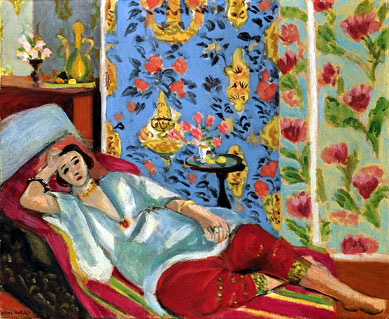
Long Lost Rooms of Matisse


That blue day came and it stayed all night
Blue morning. Blue midnight.
The city fell and then you were gone.
What is love but a robin's song?


(1)


Ooo these days. These endless blue days.
They're perfect in their own way.
Perfect in their own way.


(2)


Ooo those days that come too soon.
Strange perfumes. Long lost rooms.
They're perfect in their own way.
Perfect in their own way.


(3)


Where does love go when love is gone?
To what war-torn city?
Ooo those blue days that stayed too long.
What is love but a robin's song?


(4)


1: Odalisque in Red Trousers / Henri Matisse, c. 1924-1925
2: The Red Room (Harmony in Red) / Henri Matisse, 1908
3: Seville Still Life / Henri Matisse, c. 1910-1911
4: My Room at the Beau-Rivage / Henri Matisse, 1918

Photo source: www.henri-matisse.net
'Strange Perfumes' lyrics by Laurie Anderson

Jul 20, 2010

Perfect in Their Own Way


Just a lovely live version of 'Strange Perfumes' along with a hypnotizing drumline (which is lurking on the album version, too, but it's almost entirely inaudible... what a pity):


Jul 19, 2010

Dress Code: Black and White


A semi-informative review of the LongHouse Reserve Summer Gala where Laurie Anderson was honoured with the (guess what) LongHouse award and where she told some of her stories within the frames of a newly arranged performance called "The Boat I Had As a Child" and where the attendants wore black and white clothes because the dress code was black and white.


(photo source: Profimedia)


This just in: the organizers called the gala "Excentrica" - why? "Because Laurie Anderson is eccentric".

Oh boy. Right again. Let X equal X. I bet satellites were out that night.

According to the photos, Lolabelle must have had a good time though. :)

Jul 18, 2010

Laurie Anderson 101


As mentioned earlier at the About Mnemosyne section, this blog does not provide instantly digestible, 'basic' information on Laurie Anderson. Nevertheless, if you are new to Laurie Anderson, the performance artist / poet / musician / sculptor / etc., these two articles are great starters for you: